Companion Planting

Similar names: trap cropping, intercropping, plant association 

Companion planting is an agricultural technique wherein various crops are grown close together to enhance growth, control pests, optimise space and boost productivity. While companion planting is associated with small-scale gardening, the general principles can be broadly integrated into large-scale operations. This approach is considered a low-input and ecologically mindful method for pest management. Rooted in traditional ecological knowledge, this technique focuses on creating mutually beneficial relationships between plants. One of the most common examples of companion planting is the Three Sisters, which is a traditional Native American growing practice that includes corn, beans and squash. Each plant serves a specific role that benefits the other crops in various ways.

Biochar

Similar names: agrichar, biocarbon 

Biochar is charcoal made from organic matter such as wood, plant materials, and manure. The organic matter is heated at high temperatures of between 300-900 ℃, with very little oxygen. Biochar is carbon rich, absorbent and does not break down easily like other soil enhancers, therefore it is able to stay in the soil for long periods of time. Thus, it can reduce the need for frequent application of compost while still promoting healthy crop growth. Biochar is a soil amendment that improves soil health by aerating the soil, as well as retaining moisture and nutrients in the soil. Additionally, due to the low oxygen burning method, carbon is locked into the soil instead of being released back into the environment. The materials used for processing biochar can range from small-scale and simple to more complex and commercial.

Assisted Natural Regeneration

Similar names: Pruning, Kisiki Hai, Managed Regrowth

Assisted Natural Regeneration (ANR) is a simple, low-cost forest restoration method that can effectively convert deforested and degraded lands into productive forests and rangelands. The method uses a blend of active planting and passive restoration techniques, which help vegetation to naturally recover by eliminating barriers and threats to their growth. ANR is similar to Farmer-Managed Natural Regeneration (FMNR), with the difference that ANR applies to degraded forest lands and rangelands while FMNR is usually practised on croplands. Overall, ANR mimics the natural systems and habitats by supporting the land processes through ANR. 

ANR is a flexible restoration approach and could be adapted to various contexts and objectives. A set of ecosystem restoration techniques are being facilitated, to eliminate obstacles to plant growth and survival. Those could vary depending on a range of factors, such as location, land type, restoration goal, etc. Hence, local community engagement is crucial for successfully implementing and managing ANR. Their knowledge of the land and ancestral traditions offers the best indication of what techniques and practices would be most beneficial. The most common ANR techniques are visualized in the figure below.
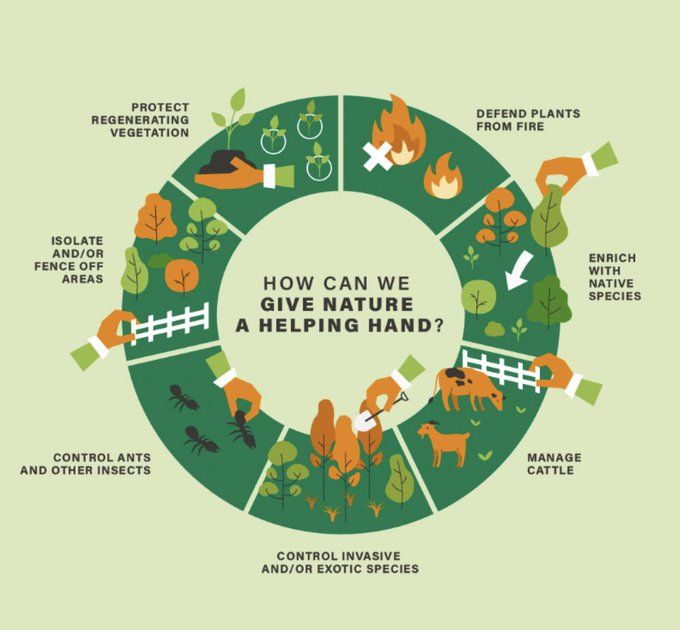
(source)

In comparison to other regeneration techniques such as tree-planting campaigns, ANR has comparatively low implementation and maintenance costs. The method could be applied on a local and larger scale level, with some areas and contexts being more favorable than others when it comes to implementation (see Requirements). However, where implemented, ANR can create jobs and bring income to local communities, as the implementations would require establishment and maintenance.

Silvopasture

Similar names: silvopastoral system, mixed pastures.

Silvopasture is a technique that integrates trees and shrubs with the keeping of grazing livestock on the same piece of land. Silvopasture interventions aim to realise the benefits of combining two systems: grazing animals help to keep weeds away from trees and fertilise the soil with manure, while trees (often fruit trees) provide additional fodder for the livestock through their extra leaves/biomass. Silvopastoral systems are used as an alternative to conventional cattle farming systems to combat deforestation problems.

This intervention is traditionally applied in tropical and temperate zones but also in subhumid, semiarid, and arid regions. Some other variations are agro-silver-pastures, which combine trees or shrubs, wish crops and cattle. A more complex system should be well planned but that can bring a variety of benefits. Also called the crop-livestock-forest system (CIF). Another alternative is silver fishery, which combines woody perennials and fish resources.

Silvopasture offers numerous ecological benefits, including improved water management by reducing runoff and increasing retention, which prevents soil erosion and landslides. It enhances soil quality and nutrient content, supports carbon sequestration through tree planting, and boosts biodiversity by introducing trees that provide habitats for various species. Additionally, it reduces the risk of fire by controlling understory vegetation and improves livestock conditions by providing shade, which can increase their lifespan and milk yield. Economically, silvopasture lowers costs by using livestock for weed control, diversifies income sources through harvesting trees and livestock products, and enhances food security and sustainability for farming communities. It also supports indigenous livelihoods by preserving traditional knowledge and culture.